


Doing school visits as an author
- Y. Y. Chan

- Dec 30, 2025
- 9 min read

On 16 December, I had the honour of visiting an all-boys' school for an author visit. What made it extra special was that the school was where I had previously taught as a Native English teacher for nine years and briefly as a junior panel chairperson for two of those years. I resigned in 2017, shortly after my dad passed away. I needed a break from full-time teaching to heal and recover. It was during this break that I discovered my passion for writing and set myself a goal to write and publish a book. Since 2020, I have published a total of nine books. And now, more than eight years after I had left the school, I was returning as an award-winning author and guest speaker, reading and sharing about one of my books. It was like a full-circle moment, being back there after all this time.
I thought I'd share about my experience in preparing and conducting the storytelling session for a school visit in this post for other authors who have never done it before or are not sure about how to prepare for one. I'm still relatively new to this kind of thing, and still learning how to do them effectively, but documenting my experience and progress is helpful for me to learn and make improvements for the future, so I hope it helps someone else too. (If you have other tips and tricks up your sleeve regarding school visits, please let me know in the comments!)
What to do before the school visit
If you are lucky and your book is well-known or you have prior connections, teachers or librarians may reach out to you directly to ask you about conducting author's talks and book readings at their schools. Otherwise, you may need to reach out to schools yourself. I was quite lucky that my former colleague from the school reached out to me and invited me to visit this time, and the other schools I had also conducted readings for were also referred by friends who worked in the schools. I haven't been actively reaching out to many schools myself, so my experience is still quite limited. In any case, it's a good idea to prepare a media kit that includes information about yourself as an author, a list of all your books, details of your services, and pricing for each item that you can send to the schools that may be interested. I made mine using Canva and saved it as a PDF so I can send it to people easily. If you would like to see mine, you can download it here. I also have a template on Canva with a quotation at the end that you can check out here. If the school is still interested in booking a visit with you after reviewing all your information, you can prepare a custom quotation (included in template) and tailor the activities according to their needs. You may consider varying the fee according to group size (whole grade level or individual classes) and duration. Then issue an invoice and state the deadlines for payment. I set a booking fee of 50% due two weeks before the date of the visit, and the remaining 50% within three days of the visit. Cancellation fees apply, and there are no refunds. (You have done the preparation work for them that costs you time and money too.) Set your own timelines and cancellation policies.
I'd also recommend preparing a book order form using an online form such as Google Forms or Microsoft Forms that you can ask teachers to send out to the parents prior to the visit (ideally two weeks). I included multiple payment options with QR Codes to make it easier for parents to pay directly and not have to go through the school or create extra workload for the teachers to hand out, collect forms and money. On the form, I gave parents the option to have the book signed with a personal message. As the orders were coming in, I started signing the books according to their requests. For this school visit, I was able to sell 30 books before I arrived at the school. I also included the link to my Amazon page with the paperback option if they were interested in ordering from there as well. I saw a spike in my Amazon sales on the day of the visit. Although I'm not 100% sure if they were related, it was still a significant spike.
Preparing the presentation
I have been using Canva to create my presentation slides. This option is simple and easy and you can send the link to the teachers in charge without taking up their storage space. You just need to make sure the venue has Internet access. If you have it loaded on your own laptop beforehand and bring in your own plugs and adaptors, then you don't even need to be connected to the Internet to play it. PowerPoint or PDF files can be very big and may not always be compatible with the different versions etc. Some fonts may not show up properly, and the sizing and spacing may shift when it's downloaded to another device or operating system. This happened to me be and I needed to quickly edit all the text on my PowerPoint slides when I was setting it up because everything shifted and messed up the layout on every slide. Since then, I stopped using PowerPoint. I haven't had any issues with Canva so far, but I do pay for the subscription to access and use all their content.
Regarding what to include on the slides, I start with a brief introduction about myself before diving into the book. Keep this part short and simple, with a few 'fun facts' about yourself. I also modify it and adjust the language according on the age group I'm speaking to. Then, introduce the book and the theme using the book cover. You can ask a few warm-up questions to get their attention and engage them (i.e. What can you see on the cover? What do you think the book is about?).
I put the pages of the book onto the Canva slides as whole spreads. I use a plain background in a soothing colour that doesn't take attention away from the interior pages. You may ask some questions during your reading or ask students to put their hands up if they have had a similar experience or agree with something. Keep them simple and short so they don't disrupt the flow of the story too much. I included a few slides for comprehension and discussion questions directed at students at the end. If there are multiple classes, I usually invite one student from each class to answer the questions in each round or type of questions. Every type of question will have the same number of questions according to the number of classes. I normally ask three types of questions–True or False, Multiple Choice, and Discussion / Reflection questions. Discussion / Reflection questions can be the same for multiple classes since everyone's answers will be different. I had prepared some small gifts / souvenirs to give to students who answer the questions correctly or thoughtfully. Some schools may not want you give out gifts to students who answer questions, or expect either everyone gets a gift or no one gets anything, to make things equal. Just check with them beforehand if it's ok to ask questions and give out gifts.
Preparing the activities
Depending on the age level of your audience, you can also include some other relevant and interactive activities to engage them. One of my favourite activities to do with any year level is Spot the Difference. I simply place two illustrations side by side–one is the first version of the page, the other is the final version of the page by the illustrator. It's the easiest to prepare and makes all the kids excited and eager to participate. This activity also gives students a little behind-the-scenes look at how the book goes through different stages and revisions before the final product. I talk about this process briefly as well before ask students to spot the differences. I also created several activity sheets related to each of my books and select a few to do together in the session or send them to the teachers to do with the students in their own time. It's also a good idea to have some colouring sheets prepared. You might need to ask the illustrator to create these for you if you don't have the skill or software to make them yourself. I like to send these out before the visit and turn it into a colouring competition to get the kids excited about the school visit. Teachers can distribute them and collect the coloured sheets before your visit. Then, when you arrive, you can pick the winner(s) who can get a copy of your book. I sent out two different colouring sheets and selected a winner for each one.
Conducting the storytelling session: How it went
Walking to the school hall before a talk would usually make me very anxious, but I was surprisingly calm and 'chill' this time. In fact, I did not feel any anxiety at all the days leading up to the visit. I didn't even worry and only practised my reading a couple of days beforehand. It was like all those past anxious feelings that always came to me before these kinds of events just left my body and I had a new body and a new mind. My Canva presentation was already prepared from previous author visits and talks, and I only modified some of the questions and simplified the slides. I was fully prepared and ready, so there really was nothing to worry about. I felt so at ease and relaxed.
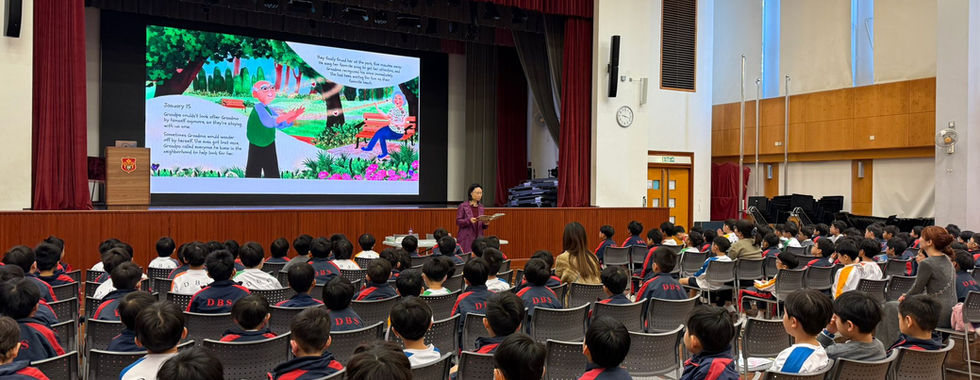
The setting up was minimal and everything was plugged in, with my presentation loaded and projected onto the big screen within five minutes. When the students started walking in, I felt excited and wanted to start talking to them when they sat down. I had asked the teachers if the students could bring in a photo of themselves with their grandparents or parents that represented a special memory that they could share during the session, and it was so wonderful to see everyone holding their photos and showing them to me as they walked in! A few students even brought their own copies of my books! They must have bought them from Amazon already. One boy held a copy of 'Can You Hear Me?' which is a chapter book for older readers, and he looked so eager and proud to show me his book! They were like my little fans!
There was a slight hiccup in the beginning with my microphone because it was slipping a little and the sound was unclear but it was quickly fixed. I had made a special request before the visit – instead of a hand-held mic, I asked for a headset mic because I wanted to hold the book in my hands during the reading so I wouldn't have to turn my head back to look at the screen to read the pages. (Yes, I wrote the book, but I do not have the whole thing memorised. I still need to read it.) Luckily, I was able to use the headset mic and have my hands free the entire time or it would have been very clumsy to hold a mic and a book and turn the pages as well. There was also no sound when I first tried to play the music video of Tik Tok Tik (original song by Debra Krol) near the end of the talk, and we had to wait for the IT technician to connect the laptop to the hall speaker system. However, everything else went pretty smoothly.
After reading the story, I asked them some questions which I had put in my slides. I was quite impressed and surprised by some of their answers! I didn't expect Grade 1 students to be so smart and be able to articulate themselves so clearly. They absolutely loved doing the Spot the Difference activity; they were jumping up and down and calling out to answer! I had to quiet them down a bit, but it was so great to see them enjoy it so much and have fun! I told them they would need to describe the differences clearly with their own words, since they could not come out and point at the screen, and WOW! their descriptions were very clear and detailed! Even their class teachers were impressed! Finally, when the song played, the boys sat so still and silently, just listening to the song and watching the music video, completely immersed in it. It was the by far the best group of students I've had for an author's visit.







Following up
Now that the visit is done and the books have been signed and distributed to those who had ordered a copy, I would consider some kind of follow up to ask teachers and parents for their feedback. This could be done via a simple message, email or even a survey form with a few questions. This would help you evaluate the session, understand what went well, what could be improved and gather specific feedback about what they thought of the book. This is all very important information and data that can be collected and used in the future as testimonials, or simply just for reference. Reach out to the teachers and parents again when you have new books out as well. Keep those contacts and build up a good relationship with them so you can be invited back again in the future! I will be preparing and sending these follow-up emails after the holidays, when everyone returns back to school.
I hope my sharing has been helpful and is encouraging for those who are starting to do school visits. Again, I am not an expert and still fairly new at this, but I have learned a lot and have tweaked things here and there to improve so I feel more confident and at ease after each one. I'm looking forward to doing more school visits in the future! Do share your personal experiences and tips for author's visits in the comments as well, if you've done them before. I'd love to hear from other experienced authors and learn from you all, too! Feel free to contact me via email or social media if you have any questions as well or would like to see my forms and templates mentioned in the post.


Comments